
Understanding Medical Billing Compliance: Your Checklist for 2026
Hoping for the best when it comes to medical billing compliance simply won’t cut it. In 2026, the financial and legal stakes are higher than ever. The cost of getting it wrong is staggering:
According to a study by Rodziewicz (2024), “the reported cost of medical errors is wide-ranging, with some experts estimating $20 billion each year and others approximating healthcare costs of $35.7 to $45 billion annually for hospital-acquired infections alone.”
To navigate this high-risk environment, you need a systematic way to verify your workflows–a medical billing compliance checklist. This promotes a culture of structure, a step-by-step method to catch errors, verify codes, and maintain financial integrity across your entire billing cycle.
Key Takeaways:
Medical billing compliance involves accurately and ethically billing for services in line with federal, state, and payer-specific regulations.
Medical billing compliance promotes a culture in which participants in a healthcare organization strive to prevent, detect, and resolve activities that could lead to fraud, waste, or abuse.
A medical billing compliance checklist helps you review established protocols and follow industry standards.
Inside this article, you’ll learn about:

What is medical billing compliance?

Why is medical billing compliance
crucial in 2026?

Your Medical Billing Compliance
Checklist for 2026

The Importance of a Medical Billing Compliance Checklist
Jump to section
Jump to section
Jump to section
Jump to section
What is medical billing compliance?
Compliance means conforming or adhering to rules. In medical billing, compliance is accurately and ethically billing for services in line with federal, state, and payer-specific regulations.
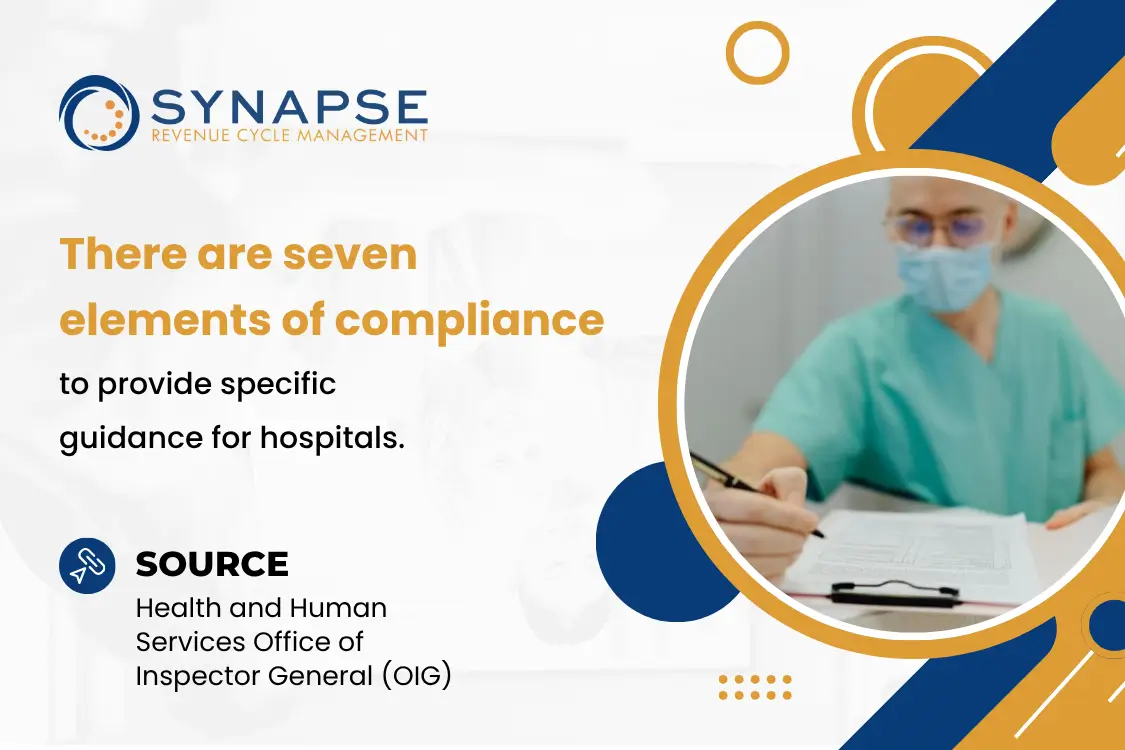
The Health and Human Services Office of Inspector General (OIG) uses the seven elements of compliance to provide specific guidance for hospitals and other healthcare organizations:
1. Implementing written policies, procedures, and standards of conduct
2. Designating a Compliance Officer for compliance leadership and oversight
3. Conducting effective training and education
4. Developing effective lines of communication—with the Compliance Officer and the Disclosure Program/Hotline
5. Risk assessment, auditing, and monitoring
6. Enforcing standards through well-publicized consequences and incentives
7. Responding promptly to detected offenses and developing corrective action initiatives
For day-to-day clinic operations, this looks like:
Correct coding
Complete documentation
Proper credentialing
Accurate prior-authorization
Timely claims submission to avoid fraud, such as upcoding or unbundling
Adhering to HIPAA, the False Claims Act, Medicare/Medicaid rules, and the Affordable Care Act
Why is medical billing compliance crucial in 2026?
AAPC says compliance is essential because it promotes a culture in which participants in a healthcare organization strive to prevent, detect, and resolve activities that could lead to fraud, waste, or abuse.
Without a compliance culture, you don’t have an organized plan with steps to prevent erroneous healthcare claims submission to healthcare insurance carriers (federal, state, and commercial).
Non-compliance can lead to the following detrimental effects:
Revenue Loss:
When billing fails regulatory standards, such as proper coding, claims are denied, resulting in late reimbursements or lost dollars.
HFMA reports that hospitals lose as much as 1% of their potential annual net revenue due to various issues associated with charge capture.
To put this in perspective, a hospital with $500 million in annual net revenue would lose $5 million.

Reputational Damage:
Billing violations can trigger media scrutiny, harming the hospital's image and complicating partnerships with insurers or affiliates.
Long-term effects include lost referrals, difficulty attracting staff, and challenges regaining market share in competitive areas.

Heavy Fines and Lawsuits:
The Office for Civil Rights (OCR) enforces HIPAA regulations and can impose civil monetary penalties ranging from $100 to $50,000 per violation.
The total annual penalty can reach up to $1.5 million for repeated violations.
For instance, the Grand Health Care System, and 12 affiliated skilled nursing facilities (collectively, the Grand) agreed to pay $21.3 million to resolve allegations of violating the False Claims Act.

Decrease in Patient Volume and Trust:
Patients may question care quality due to billing errors, prompting them to switch providers and leading to lower patient retention.
According to Langston (2024), there is a decline in public trust in health authorities and it is associated with lower engagement with healthcare systems.
Your Medical Billing Compliance Checklist for 2026
At Synapse Revenue Cycle Management, we understand that busy practices often overlook simple steps, such as checking timely filing deadlines or verifying provider credentials. However, we believe that there is an effective way to stay on track without compromising compliance.
Implementing a medical billing compliance checklist is the way to go. It shows that you have established protocols and follow industry standards, which can mitigate penalties if an error does occur.
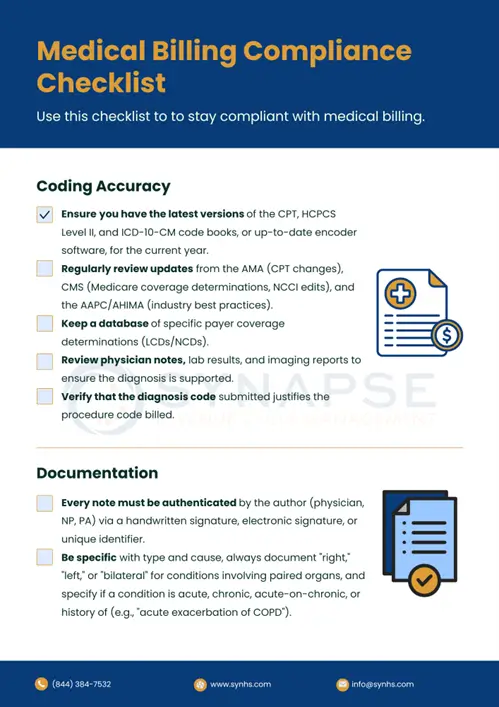
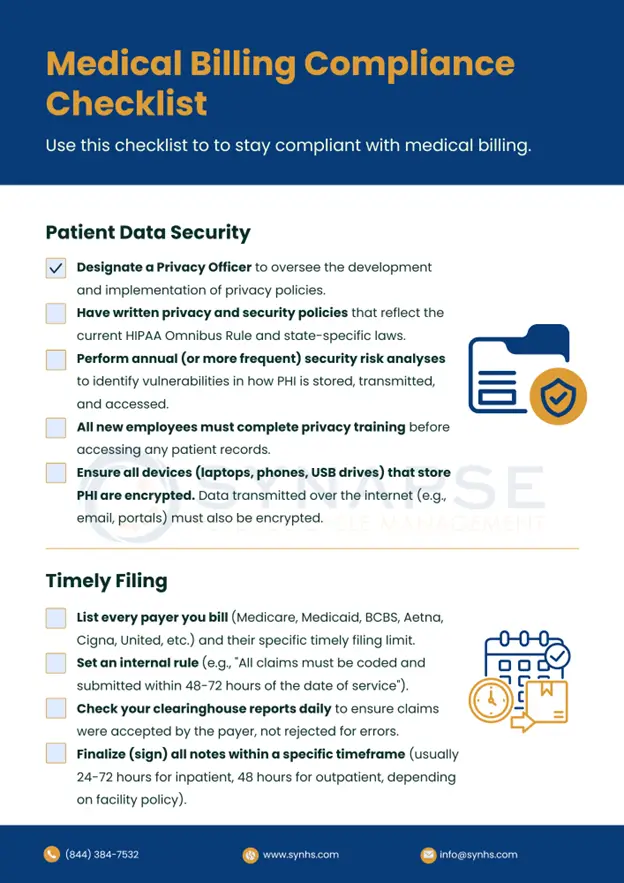
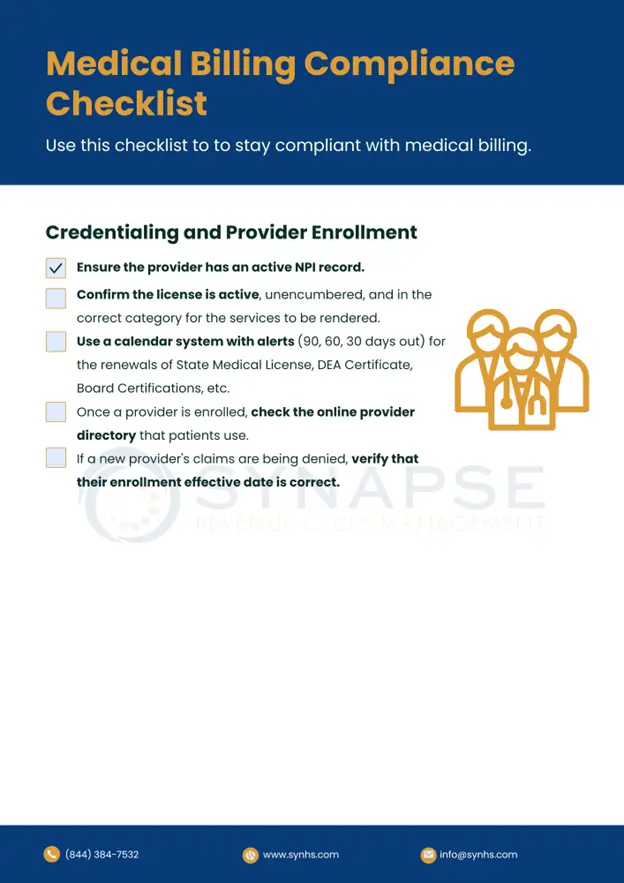
Maximize your compliance processes with our FREE Medical Billing Compliance Checklist and complimentary consultation with our medical billing experts. By collaborating with us, identify the blind spots that a standard checklist might miss. We ensure your checklist is not just a list of tasks, but a defensive tool that withstands audits and protects your revenue.
The Importance of a Medical Billing Compliance Checklist
Just as a physician needs a checklist to verify whether they have the right chart and the right patient and the correct imaging, your practice also needs one to run smoothly.
In the same way you uphold your duty to protect patients from harm, you must also uphold your duty to comply with regulations, safeguarding not only their well-being but also the future of your practice.
Guaranteed Compliance, Safeguard Your Practice
Creating a truly effective medical billing compliance checklist requires deep knowledge of constantly changing regulations. That’s the Synapse difference.
Instead of allocating hours of internal staff time to research and updates, let our experts build and maintain that checklist for you. We ensure you are always compliant without distracting your team from patient care.
Ready to build a successful practice that evolves with payer policies, so you are always audit-ready?
Sources:
Langston, C. (2023). How to Exercise Integrity in Medical Billing: Don’t Distort Prices, Don’t Free-Ride on Other Physicians. Journal of Medicine and Philosophy, 49(1).
https://doi.org/10.1093/jmp/jhad043
Office of Inspector General. (n.d.). HEALTH CARE COMPLIANCE PROGRAM TIPS The Seven Fundamental Elements of an Effective Compliance Program.
https://oig.hhs.gov/documents/provider-compliance-training/945/Compliance101tips508.pdf
Rodziewicz, T. L., & Hipskind, J. E. (2024, February 12). Medical error prevention. PubMed; StatPearls Publishing.
https://pubmed.ncbi.nlm.nih.gov/29763131/
Smith, C. (2019, September 20). Capturing All Charges: the Operational Reality. HFMA.
https://www.hfma.org/revenue-cycle/charge-capture/capturing-all-charges-the-operational-reality/
The Grand Health Care System and 12 Affiliated Skilled Nursing Facilities to Pay $21.3M for Allegedly Providing and Billing for Fraudulent Rehabilitation Therapy Services. (2024, July 10). Justice.gov.
https://www.justice.gov/archives/opa/pr/grand-health-care-system-and-12-affiliated-skilled-nursing-facilities-pay-213m-allegedly
What Is Healthcare Compliance? (2026). Aapc.com.
https://www.aapc.com/resources/what-is-healthcare-compliance?srsltid=AfmBOorUGkfl5Z3vhQBDcBxvQ3pMdZnE3P160eoCnuvpJ27aqgbfvkQk