
The Most Crucial Step in Healthcare Strategic Planning: The Planning Phase

You know you need a strategic plan. And the data backs it up. According to Becker’s Hospital Review, healthcare organizations with clear strategic plans consistently outperform their peers in financial stability, patient outcomes, and staff retention.
Yet knowing you need a plan and actually building one are two very different things. Right now, you're likely overwhelmed by daily operational fires that may lead to revenue cycle hiccups. The sheer number of moving parts in running a clinic can cause paralysis. But you don’t have to stay stuck.
With the right framework and industry-specific expertise, you can create a plan that goes beyond patching today’s gaps. It should safeguard your future as well. Especially now, in an era of relentless regulatory shifts, technological disruption, and evolving patient expectations, a well-crafted strategy is your anchor.
Key Takeaways
A healthcare strategic plan allows you to tackle daily challenges with clarity instead of chaos.
Most strategic plans fail because leaders decide what they want first, then invent reasons to justify it.
There are four phases in building a healthcare strategic plan: initial planning, planning, strategy execution, and plan evaluation.
The most crucial phase is the planning process.
Why do you need a strategic plan?
Some healthcare leaders convince themselves they don't need a strategic plan. Perhaps survival is enough, or that day-to-day execution will somehow add up to long-term success. Dr. Nguyen, a primary care leader at a mid-sized practice, used to think that way too. Then she saw the consequences unfold in real time:
Patient demand was high but the practice couldn't keep pace.
Staff morale cratered under mounting burnout.
Patient satisfaction scores began their slow, worrying decline.
And during quarterly reviews, departments were pulling in opposite directions, pursuing initiatives that worked at cross-purposes rather than reinforcing one another.
The turning point came when Dr. Nguyen finally stepped back and committed to a structured strategic planning process. She aligned her leadership team around a shared vision, clarified each department's priorities, and tied every goal to measurable, trackable indicators.
The result wasn't just a document on a shelf, but also a renewed sense of confidence. Her team began tackling daily challenges with clarity instead of chaos, and for the first time in months, they felt they were building toward something sustainable.
In short, she didn't just fix what was broken. She gave her practice a foundation strong enough to grow on. That’s what every clinic needs too.
Where most plans fail
Let’s say you do have a strategic plan. Everything looks good on paper. Still, you end up in the same cycle of poor revenue, lower patient retention, and higher claim denials. BD Emerson explains three reasons why most plans die:
1. Leaders decide what they want first, then invent reasons to justify it.
2. Most organizations build strategic plans on optimistic guesses and what people want to believe about themselves.
3. If an internal person runs the planning process, no matter how fair they are, people will suspect bias.
Ultimately, if you want a real, durable strategy, it’s time to redesign your planning process. It has to be safe for leaders to do the right thing, even when it's hard. You need to do the unglamorous work of building a truthful baseline first. Most of all, you need to step aside and let an impartial process do the heavy lifting.
A closer look at healthcare strategic planning
At Synapse Revenue Cycle Management, we have narrowed down healthcare strategic planning to four essential steps, which will help you understand how a strategic project is created.
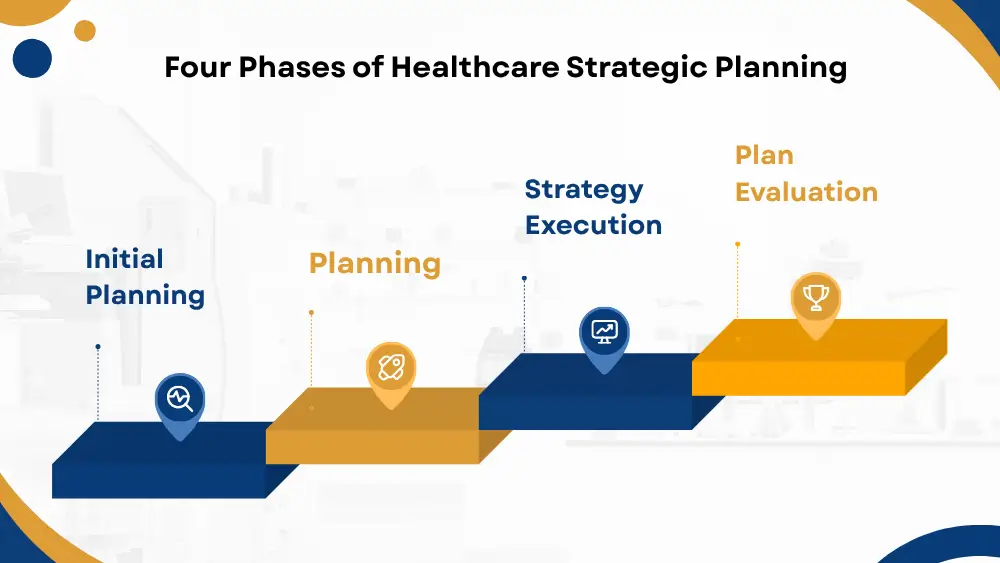

Step 1: Initial Planning Phase
This is the time to lay the groundwork by assessing your current position. Here’s how:
Use benchmarking or capability analysis to identify gaps and competitive advantages.
Conduct market research to understand industry trends.
The main outputs are a clarified plan scope, an organized planning process, and a defined list of stakeholders and committee members.

Step 2: The Planning Phase
This is the core strategy development stage, where most meetings happen.
Define your overall direction, consider internal and external factors, and select specific goals and metrics to track (e.g., operational, financial, patient care).
Recognize that healthcare planning must account for uncertainty such as technology, policy, and demographic shifts can all change the landscape.

Step 3: Strategy Execution Phase
Now, you turn your approved high-level plan into an actionable operational plan with concrete projects and tasks. Execution can be challenging, so consistent communication with all stakeholders is essential.
Regular progress updates keep everyone aligned and accountable.

Step 4: Plan Evaluation Phase
Then, you refine, monitor, and report on your plan's performance using tools like implementation scorecards.
Employ strategic frameworks such as SWOT (Strengths, Weaknesses, Opportunities & Threats).
Brand Vision Strategy.
Patient Journey Strategy.
Risk Assessment Matrices.
The most crucial step: Planning phase
Among the phases mentioned above, healthcare strategic planning truly takes shape during the planning phase. This is the part where direction, priorities, and resource alignment are decided before any money or staff time is committed.
According to UPI, the planning phase builds “the framework that tells a hospital, clinic, or health system where to put money, staff, time, and attention over the next 1 to 3 years.” During the planning phase, you can:
Set the constraints and trade-offs
Align resources with strategy.
Anticipate regulatory, financial, and market changes.
Create a culture of accountability.
Engage and motivate staff.
There are various components to the planning process of a healthcare strategic plan. See the table below for what each component covers and how it can help you.
Plan Smarter with Strategic Expertise
For over 25 years, Synapse Revenue Cycle Management has partnered with healthcare organizations of all sizes to build strategic plans that drive sustainable growth.
Our commitment goes beyond consultation: we are genuinely invested in your success, not just your survival. When you engage with us, we begin with a complimentary accounts receivable (A/R) analysis to pinpoint revenue leaks and billing errors that undermine your cash flow.
Our revenue cycle solutions are both technology-driven and patient-centered, ensuring that your patients remain loyal while you focus on delivering exceptional care.
About Us:
Synapse Medical Billing is more than a medical billing company. We are a strategic RCM partner committed to helping healthcare organizations improve both operational performance and patient satisfaction. Our approach is guided by the belief that efficient administrative processes are just as essential to quality healthcare as clinical excellence.
Source:
A Strategic Planning Fatal Flaw. (2012). Becker's Hospital Review. From:
https://www.beckershospitalreview.com/strategy/a-strategic-planning-fatal-flaw/
Kelley, R. (2026, March 26). How to Build a Vision-Led Strategic Plan for Your Healthcare Practice. Fullscript.
https://fullscript.com/blog/vision-led-strategic-plan
Sakal, L. (2026, August 27). Healthcare Strategic Planning That Survives the Budget Cycle. Bdemerson.Com; BD Emerson.
https://www.bdemerson.com/article/healthcare-strategic-planning
UPI Study Team. (2026, August 13). What Is Strategic Planning In Healthcare. UPI Study.
https://www.upistudy.com/blog/healthcare-organization-management/what-is-strategic-planning-in-healthcare